
celebrating
Max Fleischer
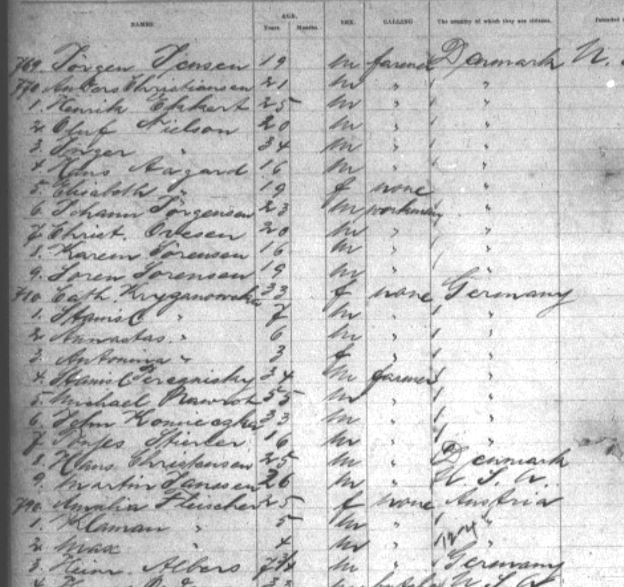
This recently unearthed document records Max Fleischer’s arrival at Castle Garden, NY on March 26, 1887 on the ship Saale. A few lines up from the bottom of this image his mother’s name (Amelia Fleischer) appears, followed by her two sons: Kalman, 5 (later known as Charles) and Max, 4.
Max Fleischer was born July 19, 1883, in what is now Krakow, Poland, but at the time was part of the Austria-Hungarian Empire. With the recent invention of the telephone (1876), the phonograph (1877) and the electric light bulb (1880), the world was on the verge of one of the most monumental shifts in human civilization: The Age of Invention. It was an age that was perfectly suited to Max’s innate curiosity, unflagging determination, and creative ambition.
The son of a tailor, Max would go on to become a pioneer of early animation and a prolific inventor, with more than 30 patents to his name. Together, Max and his brother Dave, created Fleischer Studios which was responsible for some of the most beloved and celebrated cartoons and characters in America history including Betty Boop, Popeye, Koko the Clown and the first Superman cartoons.
But that’s not all. Before turning to animation, Max was a photographer and staff cartoonist for the Brooklyn Eagle, a catalog illustrator, a technical illustrator and served as Art Editor of Popular Science Magazine.
Max’s father, William, specialized in riding outfits for wealthy New York women.
A novelist and a teacher, Max also wrote and produced many of the first training films for the U.S. Army during World War I. Years later, the army would tap him again to create training films during World War II.
Max was also well-known for his on screen appearances, especially in his early Out of the Inkwell films. He played the long-suffering straight man forever foiled by his mischievous clown creation, Koko. Later his most iconic creation, Betty Boop, would dub him “Uncle Max”.
But who was the man behind all these amazing and varied accomplishments?
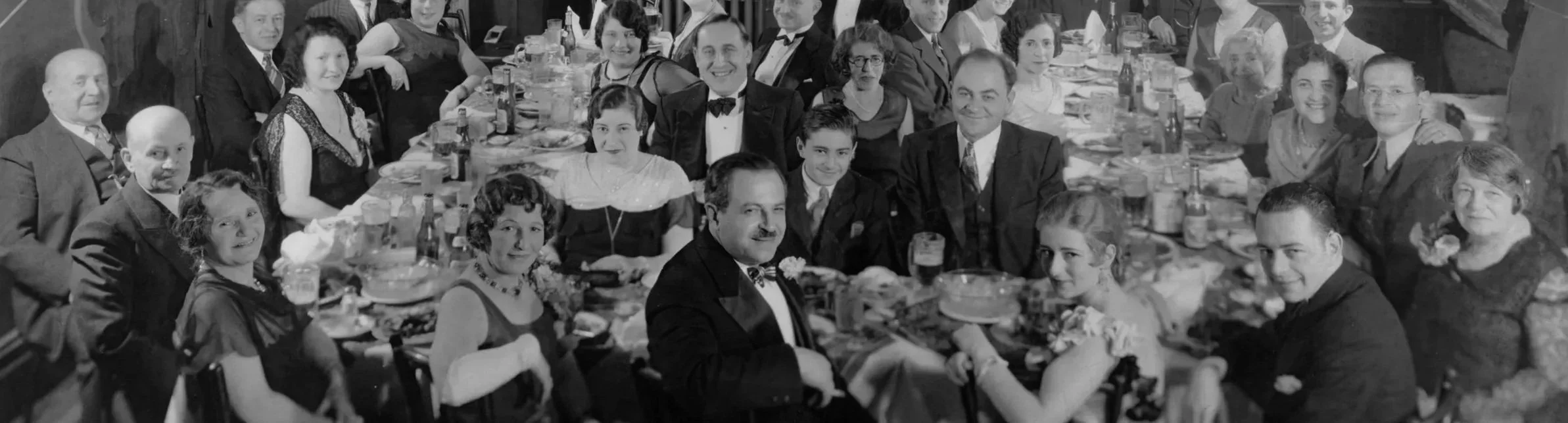
In celebration of Max’s birthday, we’re thrilled to offer this rare glimpse into the life Max Fleischer, a man who enjoyed nothing more than a great party surrounded by friends, family, music and laughter.
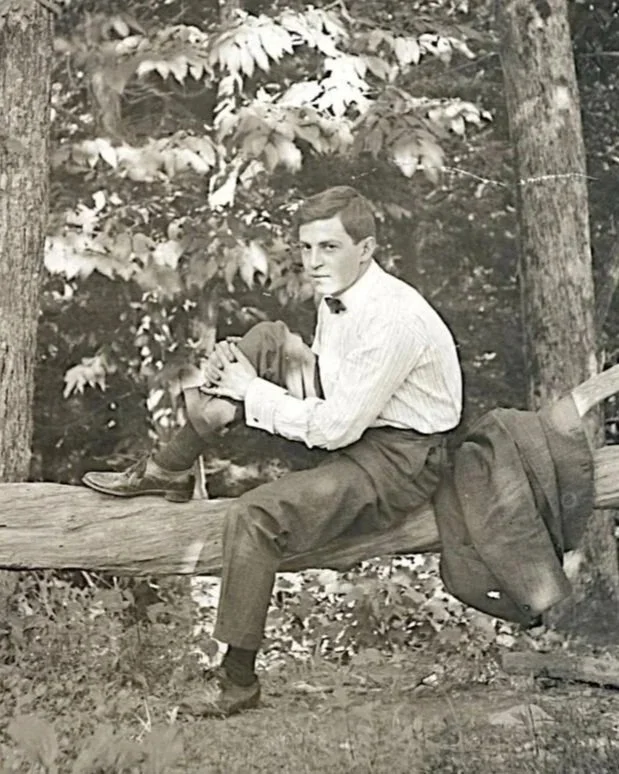
This photo of a young Max Fleischer was taken on a trip to the Catskill Mountains in 1902.
Two Brothers. One Bike.
Max and his siblings were truly life-long entertainers who, even in their youth, found opportunities to combine their preternatural flare for all things mechanical with their innate sense of timing and showmanship. The amusing story below comes from an article written by Max’s daughter Ruth for a 1969 article in Bicycling Magazine which included an amazing 1893 photo (below) of a 10-year-old Max sitting on a bicycle, his older brother Charles standing at his side.
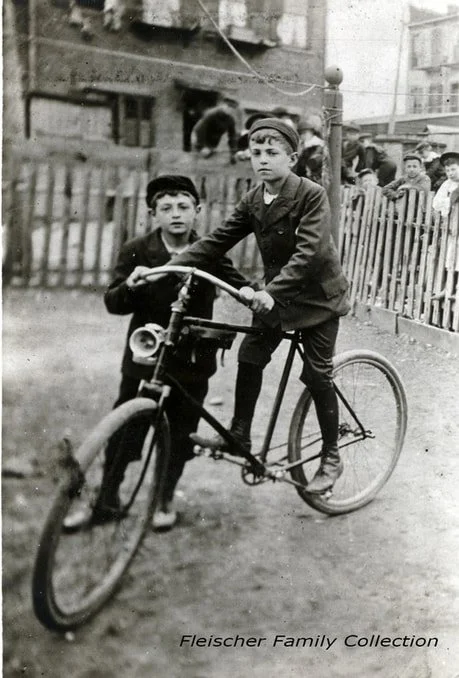
“The Fleischer family was living in Brooklyn, N.Y. at the time this picture was taken. The boys were the envy of the neighborhood- they owned a bike- a bike for pleasure only. Unheard of in those days. This was luxury living; like a kid owning a Ferrari today. Either you owned a bike so that you could go back and forth to your job, or you were a delivery boy and needed it in your work. The brothers were considered the “rich kids” in the neighborhood- playboys of the Western world.
After school and on every Saturday and Sunday a crowd of young admirers would gather around the Fleischer’s back yard to watch Max and Charlie put on their amazing, death defying, bicycle act. First Charlie would do his bag of tricks- his big specialty and wow finish was to fold his arms over his chest and steer the bike with his feet- look Ma, no hands! Max would follow this with other equally astounding feats, and the act would have as its smash finale both boys riding the bike while climbing under and around each other. Sensational! They would always get a great big hand from their awestruck and admiring audience- and an even bigger hand if one or both fell off the bike. The brothers attributed this show of disrespect to plain old jealousy. Turning deaf ears to the hooting, jeering crowd, they’d brush themselves off, get back on the bike and continue on, hoping to give the impression that the accident was really part of the act. Somehow it never worked- everyone knew they just took a plain old flop.”
Charles, a mechanical whiz, helped Max build the prototype of one of his most impactful inventions, the rotoscope, and would go on to hold several patents of his own; many for amusement park games including the still popular claw machine.
A Kid in a Candy Store
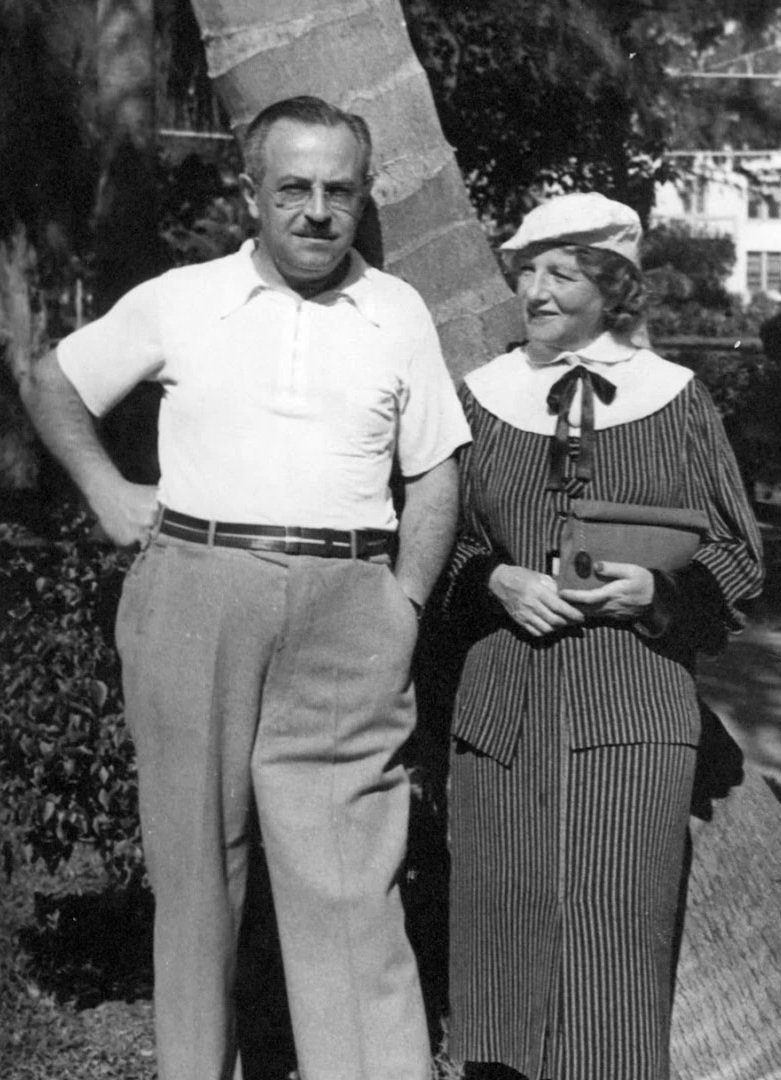
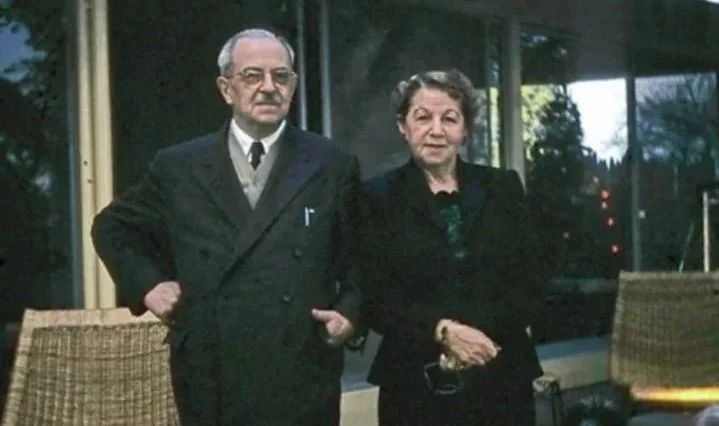
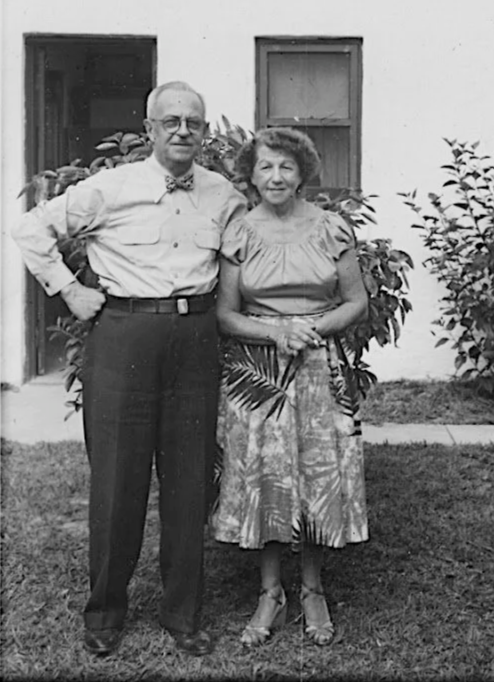
Above: Max and Essie, around the time of her marriage (1905 or 1906). Below: Max and Essie at their home in Meridian, FL in 1938. Below right: Max and Essie at Richard’s house in Los Angeles,1956.
Max drew this double heart image on many letters to Essie.
Max was twelve years-old when he met his future wife, a then ten-year-old Essie Gold, whose father owned a popular Brooklyn candy shop.
Two exchanged many letters during their lengthy courtship. Max’s letters often included the image of a double heart shot through with an arrow which he jokingly labelled as “trademarked”.
Ten years after they’d met, Max and Essie married on December 24, 1905. They would go on to have two children: Ruth and Richard who, each in their own way, followed their proud father into the family business.
Max and Essie’s wedding invitation.
Ruth, a dancer and performer from a very young age, appears in a number of Fleischer films. She transforms from an animated character into a live action dancer in Koko’s Queen, and co-starred in Carrie of the Chorus a live-action series produced by Max’s short lived Red Seals Pictures. She later worked as an in-betweener in the studio where she met and married esteemed Fleischer animator Seymour Kneitel.
Richard went on to become an award-winning film director. His diverse canon of work includes more than 70 films ranging from 20,000 Leagues Under the Sea to The Narrow Margin, Soylent Green, The Vikings, Doctor Dolittle, Compulsion and Fantastic Voyage. His book Out of the Inkwell recounts Max’s life, career and many contributions to the field of animation.
Essie and Max were married for 67 years. Max passed away in 1972, at 89 years old and Essie, who lived to be 103, passed away in 1988.
A Man of Character
Character Books, like the one shown here, were very popular in 1927 when Max’s daughter Ruth asked her father to fill in the blanks on this page of personality-revealing prompts which, nearly 100 years later offer impressive insight into Max’s interests, personality and playfulness.
Bowling, Max used to say “is the only sport I indulge in.” He served as captain of the Studios’ bowling team for many years, though he was, by his own admission, not a stellar bowler.
“My average is about 165,” he wrote in 1938, “which is very low for me. I should bowl better than that. I have bowled as high as 289, eleven points below a perfect score. That was an accident, I guess.”
Max’s passion for Astronomy can be seen in some of his early scientific films (The Eclipse of the Sun, The Birth of the Earth, Hello, Mars, All Aboard for the Moon, If We Lived on the Moon ) as well as many of his later more surreal animated imaginings (Up to Mars, A Trip to Mars, Dancing on the Moon, Reaching for the Moon).
Max studied at the Art Students League, so it’s not surprising that he selected it as his favorite school, but he didn’t attend his Syracuse University, which he lists as his favorite college. But he did live in Syracuse short time while working a catalog and technical illustrator for the Crouse-Hinds Company.
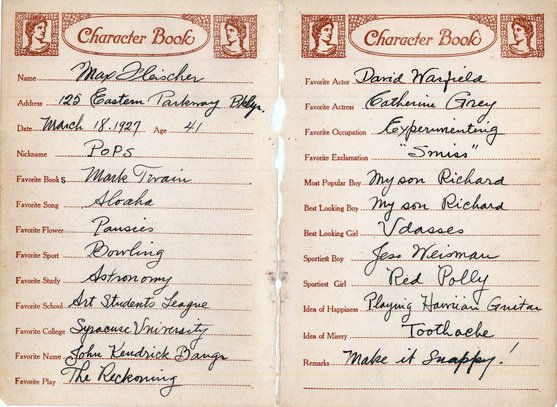
Of course, it’s no surprise that Max, a prolific inventor, listed “experimenting” as his favorite occupation, though it’s interesting to note that not all of his inventions related to animation. Some of his lessor known inventions include a calculator to be used for handicapping dog races, and a self-propelling Gravity Motor Clock.
The Exclamation, "Smiss," is a nonsense word that became a nick-name Max and his son Richard used with each other for many years.
The fact that Max lists his idea of happiness as playing the Hawaiian Guitar may strike some as a bit more surprising, but as we’ll soon hear, it truly did bring him great joy.
Max’s Mandolin
Max, like all his siblings, played multiple instruments. His father, William, a tailor by trade, insisted that all his children learn to play instruments. Max had a special fondness for string instruments and particularly enjoyed playing the Hawaiian Guitar and the Mandolin. In fact, one of Max's favorite recollections was that of the whole family playing instruments and enjoying musical evenings together.
That fact that the Fleischer brothers understood the transformative power and universal reach of music is clear in so many of their films. From the invention of the bouncing ball sing-alongs (that transformed entire theaters full of strangers into festive, musical parties) to films that embraced and celebrated the hottest jazz entertainers of the day, the Fleischers were groundbreaking in their use of music.
Max’s brother Lou, a piano player and composer, was by all accounts, the most skilled musician of the Fleischer brothers. When sound came to film the brothers lured Lou away from the jewelry business to join the studio, where he became Head of the Fleischer Studios Music Department.
Max may not have been the most skillful musician in the Fleischer household (his wife Essie joked that Max played “mostly for his own amazement”), but he put on a good show as you can hear in this remarkable recording of Max playing the mandolin for a group of friends
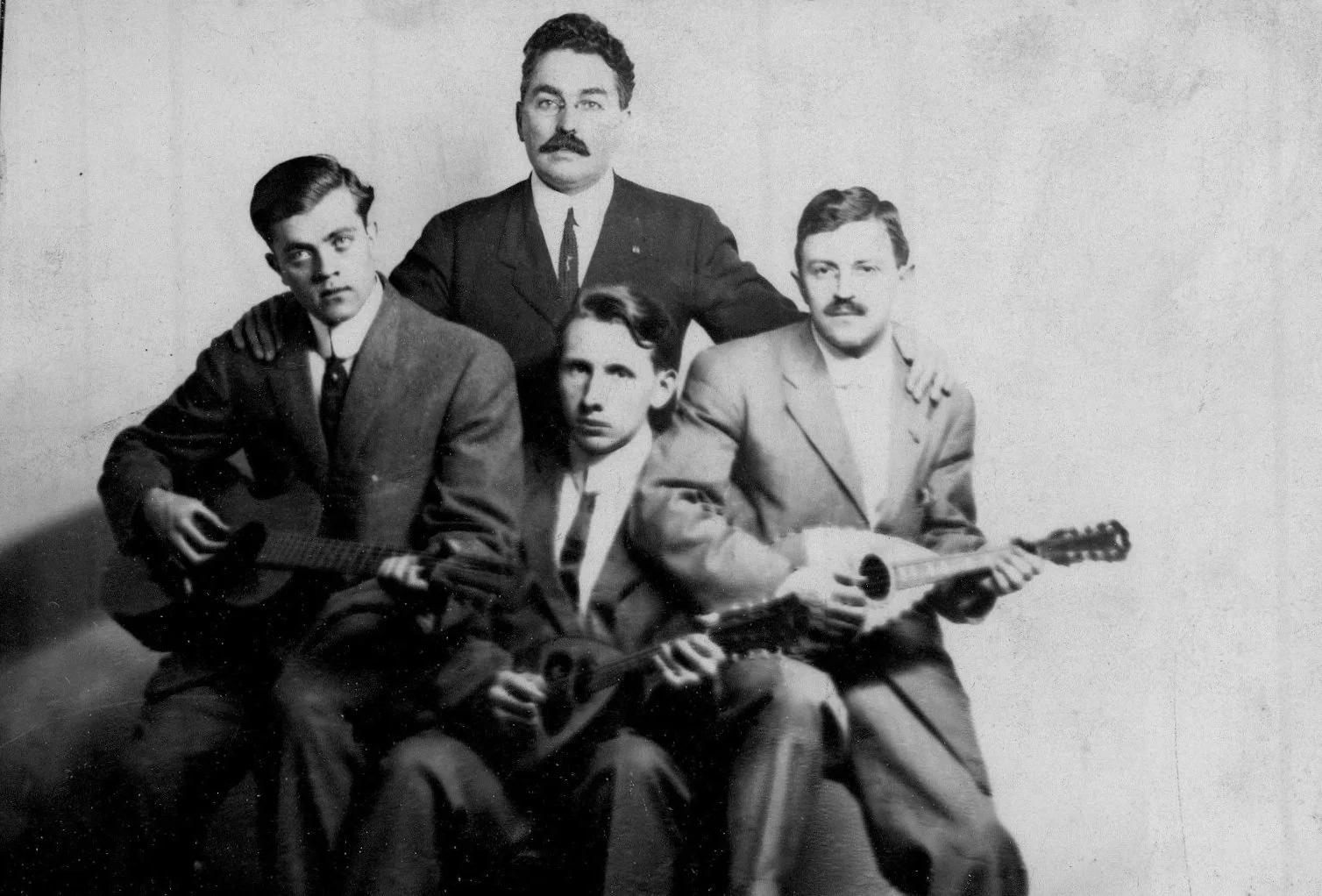
Max, far right, on the mandolin with three unknown men, was taken at “Bachelor Studio” in Syracuse, NY likely during the short period that Max worked there from 1909-1913.
Max’s Happy Birthday Sing-a-Long
What better way to celebrate Max than to join with his family and friends to sing Happy Birthday?
This amazing recording made as part of a celebration for Max’s birthday on July 19, 1941! It’s scratchy and a bit jumbled at times, but you can clearly hear the laughter and jovial enthusiasm of family members and friends.
We can identify a number of the voices on this recording. Sammy Timberg, composer of songs and music for a number of Fleischer films including the classic tune It's a Hap-Hap-Happy Day (featured in Gulliver's Travels), serves as the master of ceremonies and plays the piano.
As guests offer their birthday wishes, you can hear Sammy's wife Rosemarie identify herself; the voice following hers is Mae Questel (the voice artist best known as the voice of Betty Boop); following her on the recording is Max's son-in-law and Head Animator Seymour Kneitel.
This four-minute recording includes two renditions of the Birthday song, with slightly different testimonials from well-wishers afterward. We don’t know why the material was recorded twice, but we’ve included both versions here along with a fun, spirited song Sammy Timberg wrote for Essie and her sisters to sing. It can be heard on the recording and opens with the line: “I’m Annie, I’m Debbie, I’m Bessie…”
This recording was made with Max’s own portable 78 rpm recording equipment, housed in a suitcase. Owning this kind of equipment was very rare at the time, but Max, being someone who enjoyed anything mechanical, loved recording events at home.
As jumbled as this recording is, the warmth and affection amongst this close collection of friends and family comes through clearly. Everyone seems to be having wonderful time, and if you listen closely, you can hear Max himself, offering a heartfelt “thank you,” and declaring the cake to be "excellent."
Max and Essie at their Florida home likely around 1941.
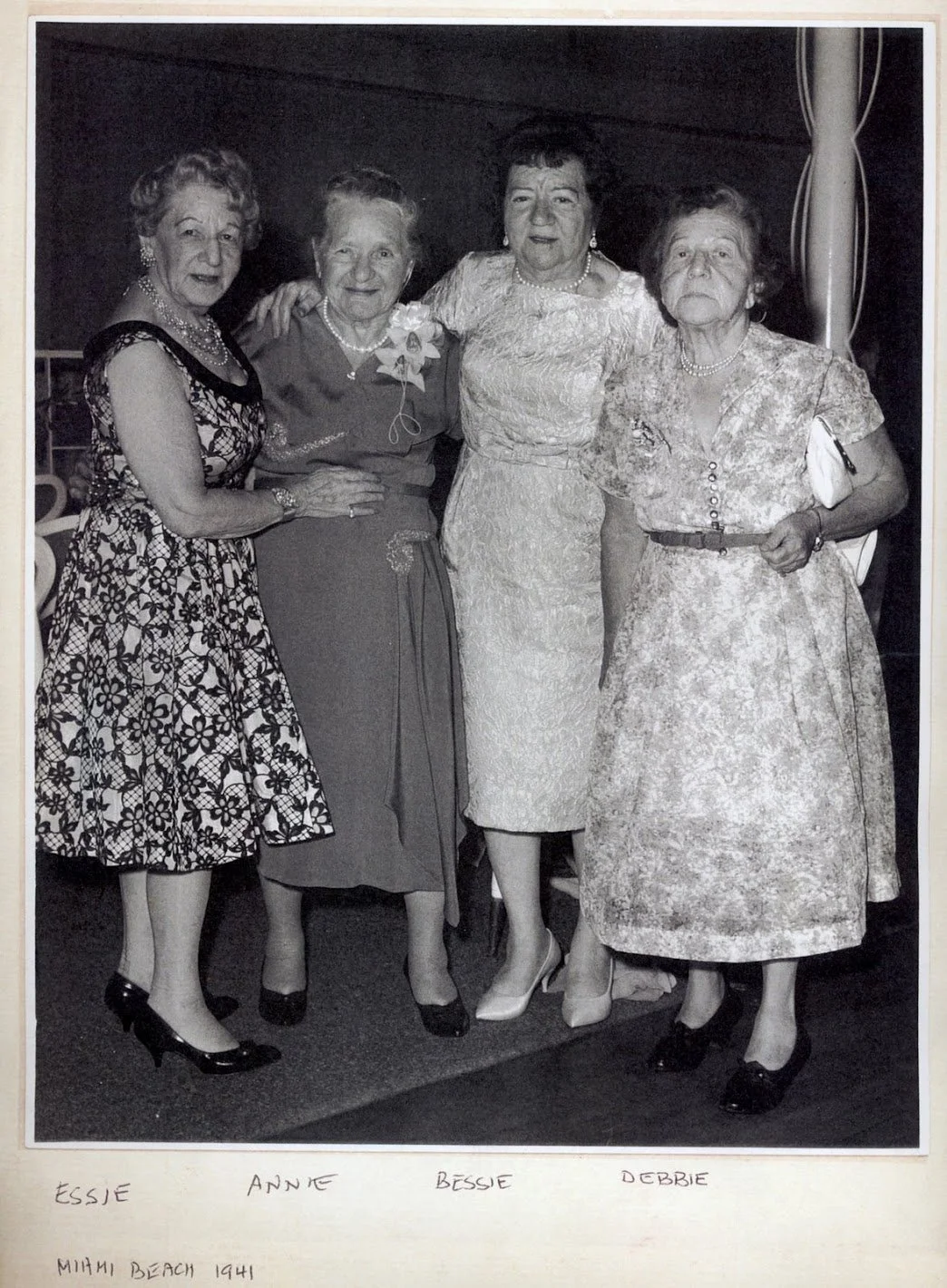
This photo of Essie and her sisters was taken in 1941.