
hISTORY & ORIGINS
The seed for what would eventually become Fleischer Studios was planted in 1915 when Max Fleischer, then Art Editor for Popular Science Magazine, invented the Rotoscope. Max was fascinated by early attempts at animation and felt certain he could improve on the jerky, unrealistic movement of these early cartoon films. Max’s invention of the Rotoscope enabled animators to use live action film as a frame by frame guide for character movements, making it more fluid and life-like. The first rotoscoped film was only about one minute long, and took a year to create, but the results were so startlingly life-like that animation was forever altered.
Dave Fleischer in his clown suit
J.R. Bray, a pioneer of early animation, was intrigued by Max’s early work with the Rotoscope. The work featured a mischievous clown whose antics were based on live footage of Max’s brother Dave Fleischer, who had worked as a clown and had his own clown suit. Bray hired Max (and later Dave) with the idea of producing a series of films featuring his not-yet-named clown to be released under the title Out of the Inkwell.
But with the outbreak of World War I, the Out of the Inkwell series was put on hold. Instead, Bray sent Max and fellow Bray staffer Jack Leventhal, a brilliant mechanical draftsman, to Ft. Sill, Oklahoma where they were tasked with making some of the first training films ever made for the US Army.
Upon returning to New York, Max worked on a number of Bray projects and was finally able to produce some of the very early Out of the Inkwell films.
In 1921, Max and Dave left Bray Studios to launch their own company: Out of the Inkwell, Inc. They hired one employee, Charlie Shettler, who continued to work for them until Fleischer Studios closed its doors twenty years later. Out of the Inkwell’s first home was a New York City basement apartment, with live action sequences for these early films created in their own living rooms. But demand for “Out of the Inkwell” cartoons quickly grew. By 1923, they had a staff of 19 and the studio was able to move into what would become its longest lasting location: 1600 Broadway in the heart of New York City.
It was during this period that the Fleischers partnered with Lee DeForest, a pioneer in the fledgling field of sound technology, to create the first cartoon using synchronized sound, My Old Kentucky Home, which was released in 1926 (nearly two years before Walt Disney’s 1928 Steamboat Willie, which is often erroneously awarded this distinction). The film also included another of the Fleischers’ early inventions, the “bouncing ball,” which provided audiences with the lyrics and rhythm of music so they could sing along.
The Fleischers put popular music at the center of many of their films, building entire cartoons around jazz legends Cab Calloway, Louis Armstrong and Don Redman. These cartoons often featured the Fleischers’ signature combination of live action and animation; in fact, the earliest known footage of Cab Calloway in performance can be seen in the Fleischer classic Minnie the Moocher.
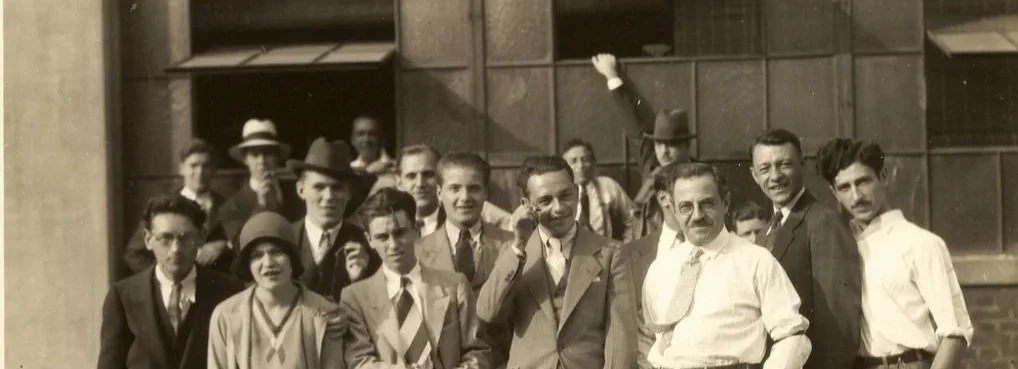
A photo of the Flesicher Studios staff at Goldman-Carpenter Labs, Long Island City, in 1929. Front row l. to r.: possibly Sid Wallick, Edith Vernick, George Cannata, Seymour Kneitel, Max Fleischer, Charles Shettler, Sid Marcus. Al Eugster behind Vernick (with hat and cigar). Behind Cannata and S. Kneitel is Abner Kneitel. Wearing a white hat (on left) is Rudy Zamora. Behind Seymour is Joe Fleischer (wearing suspenders), William Henning is man with his hand on the window.
Top: The first rotoscope, in Max’s Brooklyn living room. Middle: Jack Leventhal (left) and Max Fleischer (right) at work in Ft. Stills Oklahoma. Bottom: Charlie Shettler, Louis Fleischer and Max Fleischer, work on a “bouncing ball” cartoon.
In 1929, the Studio made a major agreement with Paramount that would allow Paramount to distribute all Fleischer films. That same year the Studio changed its name to Fleischer Studios.
The popularity of Fleischer films exploded once again with the popularity of Betty Boop, who would go on to appear in more than 100 Fleischer cartoons.
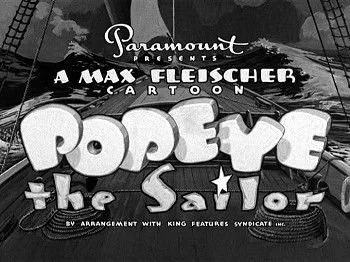
In 1932, the Fleischers secured the rights to animate an already well-known comic strip character by the name of Popeye. While the Fleischers didn’t create Popeye, (or Olive Oyl, Bluto or Wimpy), they did provide him with some of his most iconic traits, including his use of spinach to acquire superhuman strength.
Unlike other cartoon “stars” of the day, Fleischer characters like Betty Boop, Grampy, and Koko the Clown were human-based characters. With their surreal, edgy, often gritty, urban setting, the Fleischers were part of what was referred to as the ‘East Coast Style of Animation’ which differed from the ‘West Coast Style of Animation’ which included animators like Disney, that tended to feature farm animals and more rural settings.
By 1938, the studio had a staff of 250 and occupied four full floors of the 1600 Broadway building. They moved the studio to Florida toward the end of that year, and eventually increased their staff size to over 700, in order to undertake their largest project to date, the full-length animated feature, Gulliver’s Travels.
In 1941, the studio once again found success animating a much beloved comic strip character: Superman. Considered by many to be some of the best animated films ever made, the Fleischer cartoons gave Superman the power of flight (until then he could only leap tall buildings) and coined the famous phrase “Faster than a speeding bullet! More powerful than a locomotive! Able to soar higher than any plane!” The first film in this series, entitled simply Superman, was nominated for an Academy Award and is featured as one of the 50 Greatest Cartoons of all Time in Jerry Beck’s 1994 book “The 50 Greatest Cartoons: As Selected by 1,000 Animation Professionals.”
Today, Fleischer Studios is alive and thriving thanks to the timeless appeal and popularity of characters like Betty Boop, a resurgence of interest in the Fleischers and their numerous innovations, some of which, like the rotoscope and the bouncing ball, are still in use today. Their work has also earned a growing appreciation for the many lasting contributions it has made to our cultural history.
To learn more about the studio, its people, and the stories behind the scenes, visit our History Page and watch some of the amazing and wild films in our Theater section. The Fleischer Studios website, like the studio itself, is growing and ever-changing, so check back often.
You can also read more about the history of Fleischer Studios in Richard Fleischer’s 2005 book “Out of the Inkwell.”