
100 years of rotoscoping
1915 - 2015
On December 6, 2015, Max Fleischer submitted a patent application to the U.S. Patent and Trademark Office for an invention called the Rotoscope.
It was an invention that would revolutionize the look of animated films and is still widely used today. While Max didn’t receive approval of his application until October 9, 2017, the Rotoscope already begun changing the course of animation history.
100 years later, the naturalistic detail that the animators were able to achieve using the Rotoscope is still extraordinary, and the playful, imaginative and sometimes bizarre ways in which animators used this new technology as the jumping off point for expressing their own vision, artistry and humor feels fresh, fantastical, and even a bit daring.
The footage above, featuring clips from two early Fleischer films featuring jazz great Cab Calloway (Minnie the Moocher and Snow White), offers a remarkable side-by-side comparison of live action and Rotoscoped animation.
Originally posted on December 6, 2015
Before the Rotoscope
Early in the 1910s, Max Fleischer was a young artist working at Popular Science Monthly when his boss, Waldemar Klaempffert, suggested Max combine his mechanical skill with his artistic talent and interest in photography to improve the stiff, jerky movement that plagued early animated films. The movement of people was especially unrealistic. Their movements were rigid and their limbs – sometimes their entire bodies – would suddenly appear or disappear.
For Max - a lifelong tinkerer from a family of tinkerers – who had long been fascinated by the transformative potential of the still young science of film, the challenge of figuring out a solution to this puzzle was tremendously appealing.
Early animated films were hampered by rigid, jerky movement.
Max’s Big Idea
Max reasoned that if animators were able to use the frames of live action film as a guide, they could create a series of drawings that, when strung together, would have a more lifelike flow. The question was how to make this idea into a functional and practical reality?
What one needed was a device that would enable the animator to project the film, one frame at a time, in such a way that the animator could use the image as a guide for his own work. The solution was to project the film onto the back of a small glass panel, allowing the animator to place a sheet of paper on the top side of the panel and create drawings using the projected image of motion as it unfolded frame-by-frame.
Because film during this period was shot at a rate of 16 frames per second, this would mean creating an enormous number of drawings: every second of running time would require 16 different drawings.
Once the animator had meticulously drawn all of these images, each one would have to be individually photographed so that, when strung together and projected, they would create the illusion of lifelike motion.
The device that would make all this possible, and which would eventually become known simply as the Rotoscope was originally filed under the title Method of Producing Moving-Picture Cartoons.
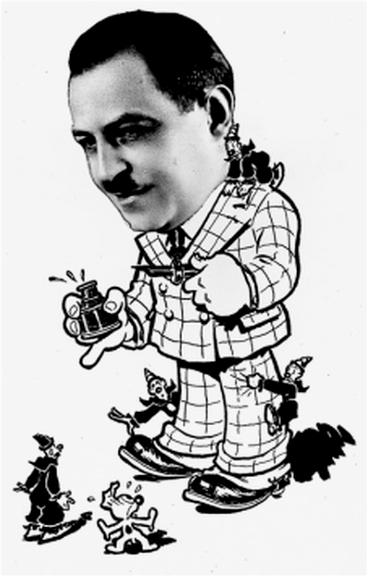
putting the idea into action
Max told his younger brother Dave about the Rotoscope idea. Dave, a film editor for Pathé at the time, was similarly fascinated by the idea. Together they took on the challenge of building the device that Max had imagined.
The first thing they would need a camera, which they did not have. But what they lacked in funding, they made up for with determination and innovative thinking. Using their shared penchant for tinkering, the brothers converted an old hand-cranked Moy projector (left over from a failed outdoor theater venture Max undertook with his brother-in-law, Max Bertin, a year earlier) into the main component of their device.
They also benefitted from the talent and generosity of their brothers: Joe, a master electrician, and Charlie, a mechanic, who both volunteered their services. And Max’s wife, Essie, offered up $150 she had managed to save from the household money.
And, of course, they would need was someplace to build, test and ultimately create an animated film with their new device: a space that was large enough for them to work in, but cheap enough for them to afford, and would let them work at night because they all had day jobs. Once again, Essie came to the rescue, agreeing to let them build their invention in the family’s living room.
Making it Work
The concept for the Rotoscope was relatively simple, figuring out how to make it work was anything but. Every evening for nearly a year, the brothers met in Max’s apartment at seven and work until three or four in the morning. The work of meticulously projecting and creating drawing after drawing after drawing was slow, tedious work. According to Max:
”It was almost a year from the time we started that we got a piece of film 100 feet long. A piece of film you could see on the screen in a minute. This represented a year’s work but it proved that the theory was correct.”
That one minute of film time required almost 2,500 individual drawing!
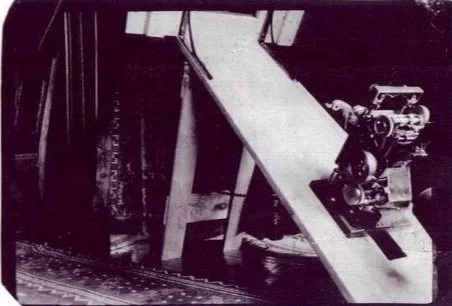
An early version of the Rotoscope in Max and Essie Flesicher's living room.
Back to the Drawing Board
While Max had proven his theory, he also knew that taking a year to create one minute of film wasn’t practical. The brothers went back to the drawing board, determined to create a process that was possible, and practical. Eventually, Max was able to produce about 100 feet of film every fourth week and it finally seemed as if the Rotoscope had some concrete, real-world potential.
But Max still had one more hurdle to jump, and it was a big one: he and Dave were still just two guys with day jobs, working nights in Max’s living room. Max needed to connect himself to a company that would enable him to make and, most importantly, distribute his Rotoscoped films.
Fortunately, in 1916, Max was able interest another early animation pioneer, J.R. Bray - who had his own studio - in the Rotoscope. Bray hired Max to work on projects as assigned, including films created with his Rotoscope. But when World War I broke out, Bray ended up sending Max to Oklahoma to create technical training films for the U.S. Army. It wasn’t until Max returned to the Bray home office in 1918 that he was able to return to creating work using the Rotoscope.
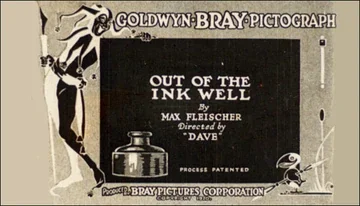
The Little Clown is a Big Hit
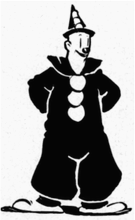
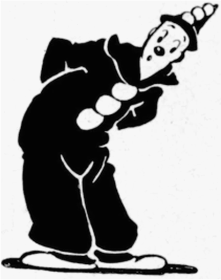
The star of these early Rotoscoped films was a ‘little clown.’ Max’s brother Dave, who had worked as a clown had his own clown suit and served as a live action model for the little clown. According to Max:
“I selected the character “Koko the Clown” because he would be universally understood in pantomime. The title ‘Out of the Inkwell’ was used for want of a better name. The pictures were done in pen and ink. In addition, there are so many things that can come out of an inkwell.”
In the age of silent films, Max’s ‘little clown' whose antics could be understood and appreciated without the need for language, quickly rose to fame. A lengthy article in the New York Times (‘The Inkwell Man,” Feb. 22, 1920) describes the clown:
“This little inkwell clown has attracted favorable attention because of a number of distinguishing characteristics. His motions, for one thing, are smooth and graceful. He walks, dances and leaps as a human being, as a particularly easy-limbed human being might. He does not jerk himself from one position to another, nor does he move an arm or a leg while the remainder of his body remains as if it were fixed in ink lines on paper... “
Dave eventually joined Max at Bray and the brothers continued to work there until 1921, when they left to form their own studio “Out of the Inkwell, Inc.” This is the studio that would eventually become known as Fleischer Studios and the place where, in 1923, the ‘little clown’ finally got his name… Koko!
Success!
It was Max himself who, more often than not, served as Koko’s foil: the embattled animator and the victim of Koko’s pranks, and patient but stern parent who must ultimately tracks down his unruly ward and send him to his room, which in Koko's case was his ink well.
The Fleischers went on to use the Rotoscope in many other films. Gulliver was Rotoscoped in Gulliver’s Travels, as were the human characters in Mr. Bug Goes to Town and some of the characters in their famous Superman series. But the most amazing examples of Rotoscoping created by the Fleischers are their films featuring Cab Calloway. In the Fleischer version of Snow White, Cab Calloway is Rotoscoped first as Koko and then as a ghost who dances and sings St. James Infirmary Blues.
Koko was an enormous success for the Fleischers, both technically and artistically. Technically, Max’s use of the Rotoscope, combined with his ingenious talent for incorporating live action film sequences into his work, created a fantastic new world in which an animated clown could ride on a live-action house cat or transport ordinary people to the furthest reaches of outer space.
The Rotoscope Today
While the Rotoscope is often associated with animated cartoons, over the years it's been widely used in dozens of live action films, video games, music videos and commercials. In fact, Wikipedia has compiled a lengthy (and sometimes surprising) list of Rotoscoped Works including everything from Star Wars to The Good, The Bad and the Ugly to The Bride of Frankenstein.
Over the years, Rotoscoping has been adapted to create computerized visual effects. Although it’s applied somewhat differently, the principle is very similar to the original Fleischer invention, so much so that the process is still referred to as Rotoscoping.
Fun Facts: Work from Home Edition
Even in the early 1900s, working from home had it’s challenges, as Max’s experience demonstrates…
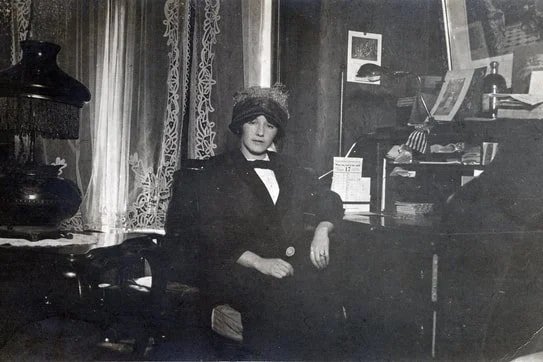
Max’s wife, Essie, in the living room of their Brooklyn apartment, where the first rotoscope was created.
“One evening we met as usual, and with us was my brother Joe, who had joined us too. We were getting pretty tired abound 3:30 A.M. The household was asleep. I turned around and my elbow hit a bottle of ink and knocked it off the table and made a great big blot on the edge of the carpet. The blot was about as big as five fried eggs and we couldn’t get it out. I knew right then that the experiment was over if the missus ever saw that. So quietly we tried to blot it up but it only looked worse. I said, ‘Where do we go from here?’
At 3:30 A.M. the three of us moved all the furniture out of that room, including a darn heavy upright piano, into the dining room, turned the rug around so that the spot came under the piano and we went on with our experiments for six months. Then we moved, and the ink spot was discovered. I got the same hell as though it had just happened.”