
when
fleischer studios
made
television history
Who created the very first animated cartoon to be broadcast on television?
And this is how it happened…
fleischer studios!
Television was still very much in its infancy in 1931. Though they introduced in the U.S. in 1928, televisions remained new and experimental for several years; there were only a handful of channels, no scheduled programs, and were rarely found in private homes. For most people, having a radio was considered remarkable.
Serious interest in developing TV in the U.S. began in the mid-1920s, but a major challenge was transmitting images of sufficient quality. To improve transmission, early developers used a statue of the animated character Felix the Cat. Placed on a turntable that rotated slowly, an image of the statue was broadcast to televisions at a remote location. Felix was just right for this purpose: his black-and-white design reproduced clearly, he could remain still for hours, and he was unaffected by the intense heat of studio lights.
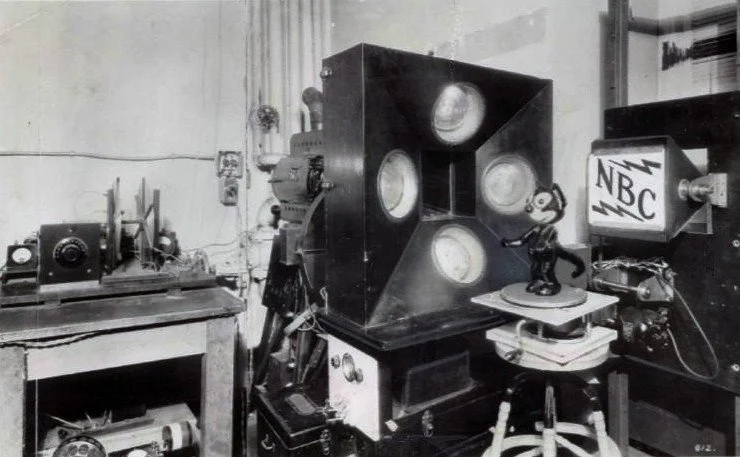
Felix the Cat in NBC television studio circa 1928. Photo issued by NBC.
The first image of Felix to be transmitted appeared only 2 inches tall on the then-tiny screens of the time. It was broadcast for two hours a day, enabling engineers to make adjustments for depth of field, a continual problem for early television: the tip of someone’s nose might be in focus, but their ears would be blurry.
Felix rotated like this for almost a decade while studio engineers worked to improve the quality of early transmitted images. Except for rotating on the turntable (and occasionally falling off), Felix never moved!
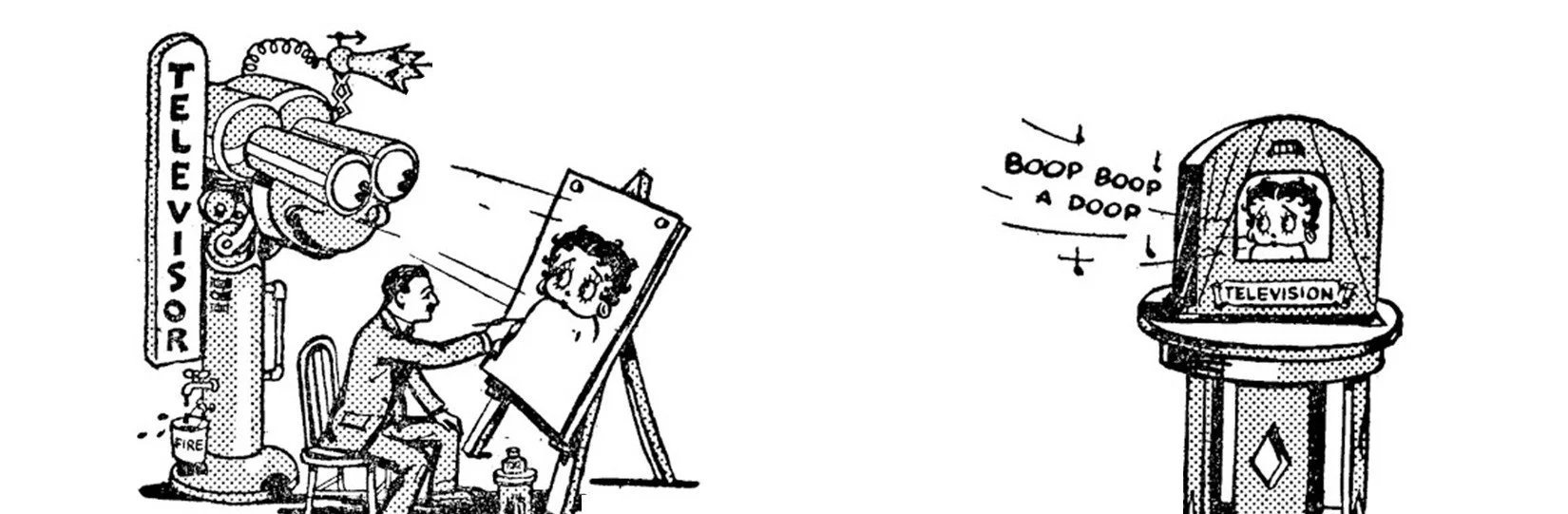
SHE moves, She talks, she sings!
Well before she’d evolved into the animated icon we know today—and before she even had a name—the sassy songstress with puppy dog eyes, a button nose, and rolled down stockings captured Bimbo’s heart in the 1930 film Dizzy Dishes and quickly captured the imagination of audiences across America. That popularity made her a natural fit for the new medium of television, which often featured familiar stars in a variety-show format that mimicked the popular live-action style of vaudeville entertainment.
As Major Ivan Firth and Gladys Shaw Erskine recount in their book Gateway To Radio, one early television broadcast- and the first known broadcast of an animated character- featured Max Fleischer, who made use of his famous Out of the Inkwell routine to draw his new, quickly rising starlet who “rolled her eyes, blinked her famous lashes, and then, without more ado opened her pouting mouth and sang.” They go on to note that is was so successful that it was, “the only feature that it was selected as the only program to be presented at the World’s Radio Fair at Madison Square Garden on the ten foot screen.”
Madison Square Garden
The authors don’t provide the date for this presentation, but we do know that Max did make his next television appearance at 1931 at the Radio World’s Fair at Madison Square Garden in New York City. The authors report that:
“Although scheduled for only one performance, the program was repeated nearly 30 times to the delight of Mr. Carveth Wells, who was acting as special announcer.”
One of the many people working to develop television at the time was Ulises A. Sanabria, who envisioned it mainly as a tool used by theaters to exhibit motion pictures. As a result, he focused on creating large-scale viewing screens, such as those he used in Madison Square Garden which consisted of a ten-foot-tall sheet of plate glass, frosted on one side and weighing 350 pounds, with the image projected from behind.
This demonstration, which was referred to as a “television talking moving picture,” was reported a 1931 The New York Times article entitled “Television Stages a Talking Picture”. According to the Times:
“Sanabria, the inventor of the Television apparatus said he had been besieged with questions… As a result of this interest in television the Short Wave concern announced yesterday that steps had been taken to begin production as soon as possible on a television receiver for home use.”
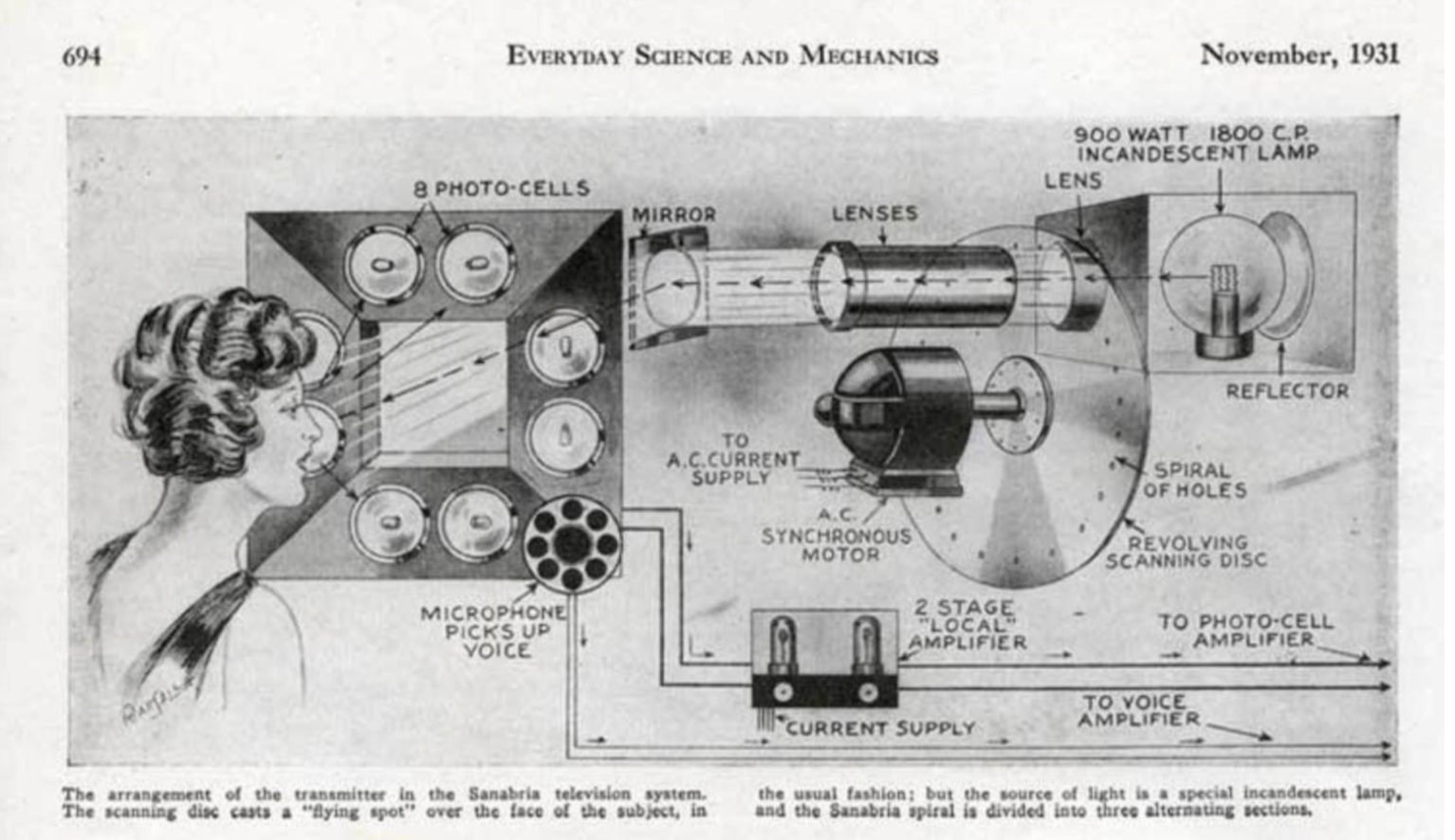
A diagram of the television used at the 1931 Radio World’s Fair as featured in the November 1931 issue of Everyday Science and Machines.
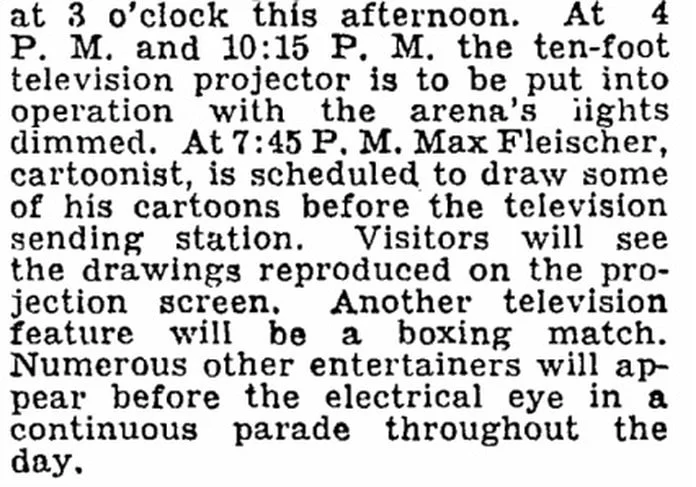
Portion of The New York Times article about the Madison Square Garden demonstration using Sanabria’s equipment. (September 25, 1931)

Fun Fact
Cartoon characters being fully animated, did not suffer from the depth of field problems that plagued three-dimensional live performers in the early days of television (including the Felix doll turning endlessly on his turntable.)
One can only imagine that this clarity of image made Max’s 1931 television demonstrations even more remarkable!