
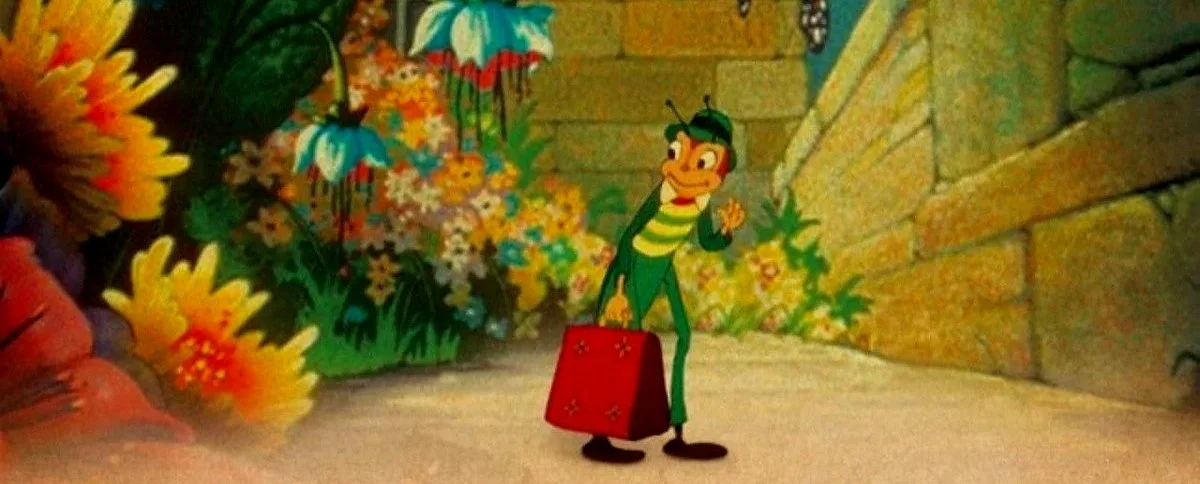
Mr. Bug Goes to Town
Part 2:
The Story About Making the Movie
In Part One, we looked at the creation of the Mr. Bug story-line. After months of developing and discarding a variety of concepts, the studio finally had a wholly original story-line involving an entire colony of anthropomorphic insects, a city full of humans, and the towering landscape of New York City. But, the task of bringing Mr. Bug to the screen had only just begun.
With a budget of $1,000,000, and a production schedule that - from final script approval to finished product - was less than a year, the making of Mr. Bug Goes to Town was an incredible feat involving more than 700 staffers - including writers, animators, inkers, opaquers, musicians and camera technicians.
In Part Two, we look at the actual making of Mr. Bug Goes to Town, and how - working in an era during which every element, from individual animation cells to dimensional background sets, had to be precisely and painstakingly created by hand - the staffers of Fleischer Studios made use of innovative techniques and ground-breaking inventions (many of which they themselves had developed) to bring this beautiful film to life.
Film Daily - 2/6/1941
The 'set-back' process
The spectacular opening credits of Mr. Bug were created using Max Fleischer’s patented ‘set-back’ process. Not only did it offer the viewer a stunningly realistic sense of dimensionality, it also created the illusion of actually moving through space.
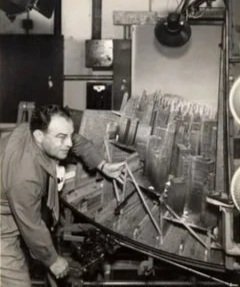
Above: The 'set-back' process enabled Fleischer animators to achieve a stunning degree of dimensionality. Below: Director Dave Fleischer turns the ‘set-back’ model built for the film's opening scene.
In order to achieve this, an actual three-dimensional set, in miniature, was built on top of a revolving steel turn-table. The set was constructed in distorted perspective which served to enhance the illusion of three-dimensional space. Using a specially designed camera, animated drawings were then placed 6 feet in front of the camera and photographed one at a time, with the ‘set’ in the ‘back’ being moved very slightly each time another drawing was photographed.
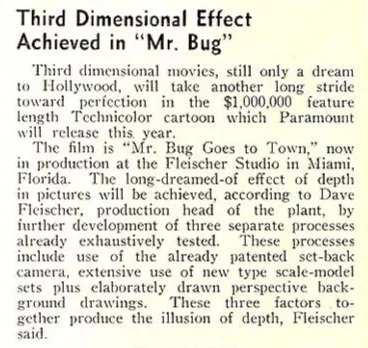
The set of New York City featured in the opening credits of the film was made of painted balsa wood and plastic. Although this breath-taking opening sequence takes less than two minutes of screen time, it took Fleischer artists four months to construct and shoot it.
There was great excitement within the industry surrounding the Fleischers' use of this 'set-back' process, which was viewed as a significant step forward in Hollywood's ambition of achieving a fuller sense of dimensionality in animated film.
April 26, 1941: Showmen’s Trade Review
Model Sheets, ‘Marquettes’ & Scuptures
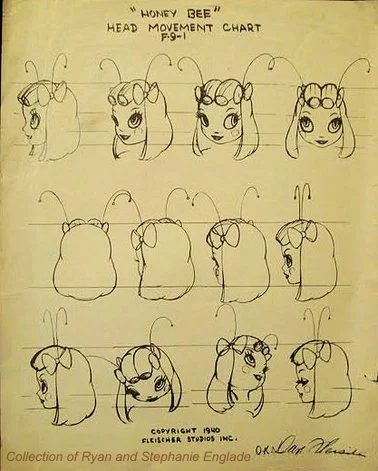
A model sheet of Honey Bee (from the Collection of Ryan and Stephanie Englade.)
Since many different animators might be doing drawings of the same character, it was necessary to have guidelines, or standards, so that each character- no matter who drew it- would always look the same.
By the time Mr. Bug was made, it had become standard practice in animation to develop model sheets for each character in a film, like the one of Honey Bee featured here.
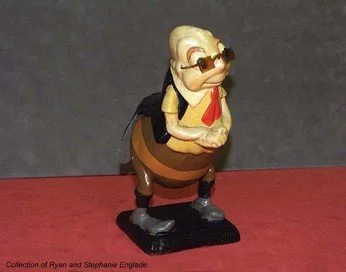
A ‘maquette’ is a small sculpted statue of an individual character.
These maquettes served as a kind of three-dimensional version of model sheets, giving animators a fuller sense of the character's actual physical presence in space.
Just several inches in height, these small sculpted pieces were created in limited numbers. Only a few, including the maquette of Mr. Bumble (left), have survived.
For Mr. Bug the Fleischers went a step further and created human-sized models of the film's main characters. In addition to enhancing the animators’ sense of these insects as fully-realized, multi-dimensional characters, they appear to have provided the staff with some fun and very entertaining opportunities. This playful clip (left), from one of the animator's home movies, was shot just outside the Studios' Miami home during the making of Mr. Bug.
Maquette of the character Mr. Bumble (from the Collection of Ryan and Stephanie Englade.)
Staff animator Reuben Grossman monkeys around with Honey Bee. Film footage courtesy of the Lynn and Louis Wolfson II Florida Moving Image Archives.
The Rotoscope
Another of Max Fleischer’s inventions, the Rotoscope, was used to create the illusion of fluid, naturalistic motion for the human characters in the film. The ‘human’ sequences in the movie were actually first filmed using live actors so that animators could study their movements frame-by-frame. Then, using the Rotoscope, they create their drawings based on the filmed images. Find about more about the Rotoscope in our Rotoscope exhibit.
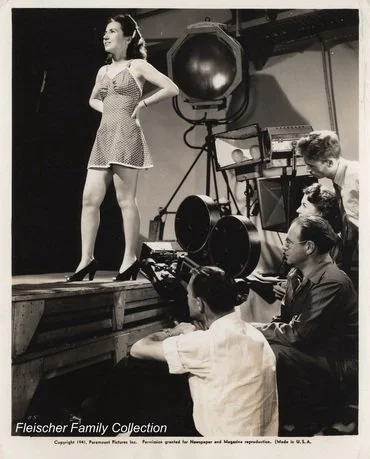
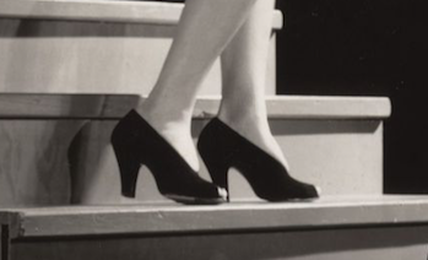
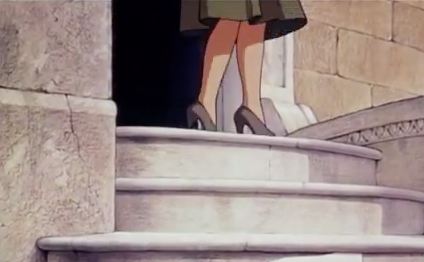
Above: A camera photographs Roberta Bottcher’s feet so artists can view them in slow motion and copy their action using the Rotoscope. Director Dave Fleischer is sitting in back of the camera. Left: Close-up photo of Roberta Bottcher's feet. Far Left: Her Feet as they appear animated in the film. All Fleischer Family Collection
It is interesting to note that while the movement of the humans is extremely naturalistic, they are always seen from an insect’s point of view. Humans in this world tend to be made up chiefly of enormous feet or an occasional arm, and, except for one brief scene at the film’s beginning, the heads of ‘the humans’ are never seen.
An insect’s eye view…
“…a plot of grass in a glass case was placed close to and high above their (the artists) heads so that they could obtain the towering perspective a blade of grass has for a little member of the animal kingdom. Weeds, small shrubs and other really small flora when viewed from that perspective enabled the artists to draw backgrounds which literally towered over the tiny actors.”
Because the film takes place from an insects’ point of view, the animators had to envision the world, and their work, from that perspective. As a promotional booklets distributed to theaters in advance of the film explained:
The Man in the Mirror
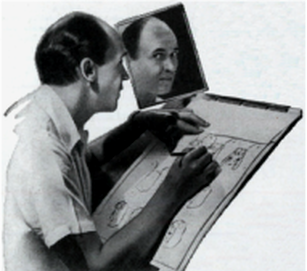
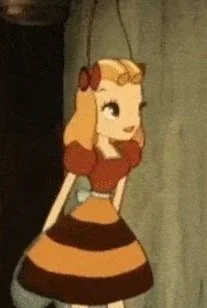
In addition to all the other tools they had at their disposal, the artists of Fleischer Studios also had their own faces.
In the image (left) animator Graham Place examines his face in the mirror and tries to look like a lovelorn girl as he draws the character Honey Bee.
The Music
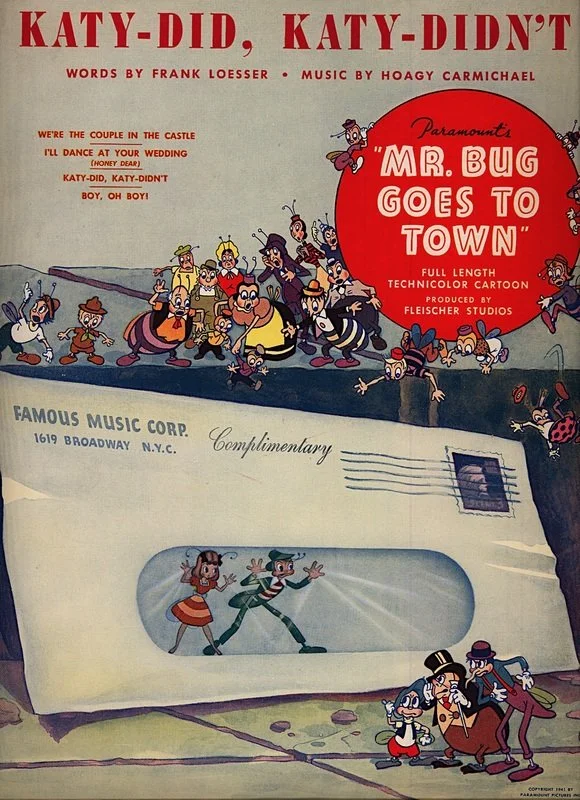
As in all Fleischer films, music played a central role in Mr. Bug. Two very well known song writers, Frank Loesser and Hoagy Carmichael, along with long time Fleischer staff composer, Sammy Timberg, wrote the words and music for the songs. For Loesser and Carmichael, already well known for their extensive work on Broadway (Loesser) and in popular music (Carmichael), working on an animated film was a somewhat unusual assignment. Together, the three provided the film with a musical score that included such well known songs as Mr. Bug, Be My Little Baby Bumble Bee, and We’re the Couple in the Castle. Background and atmospheric music is credited to Leigh Harline.
Fun Facts
Fun Fact 1: hang nail insurance
According to The New York Times (February 15, 1942), Fleischer Studios took out a $185,000, all-risk policy with Lloyds of London to cover the hands of its prize cartoonists during the making of Mr. Bug Goes to Town. The policy “provided for an indemnity if an artist could not draw because of ingrown fingernails, sunburned hands, skin irritations, bone fractures, ligament strains, sprains, burns, infections and finger cramps arising from any arthritic cause.”
Covering the 116 main artists, it also contained an extra double indemnity clause in the event one of them should lose one or more fingers while working on the film!
As the Times points out, the Fleischers were “understandingly sensitive to the prospect of injuries that might hold up production and increase the already-high cost of making a film."
In the end, the policy turned out to be a good bet for the insurance company as “there was not so much as a sprained finger on an artist’s hand.”
Fun Fact 2: in the mood
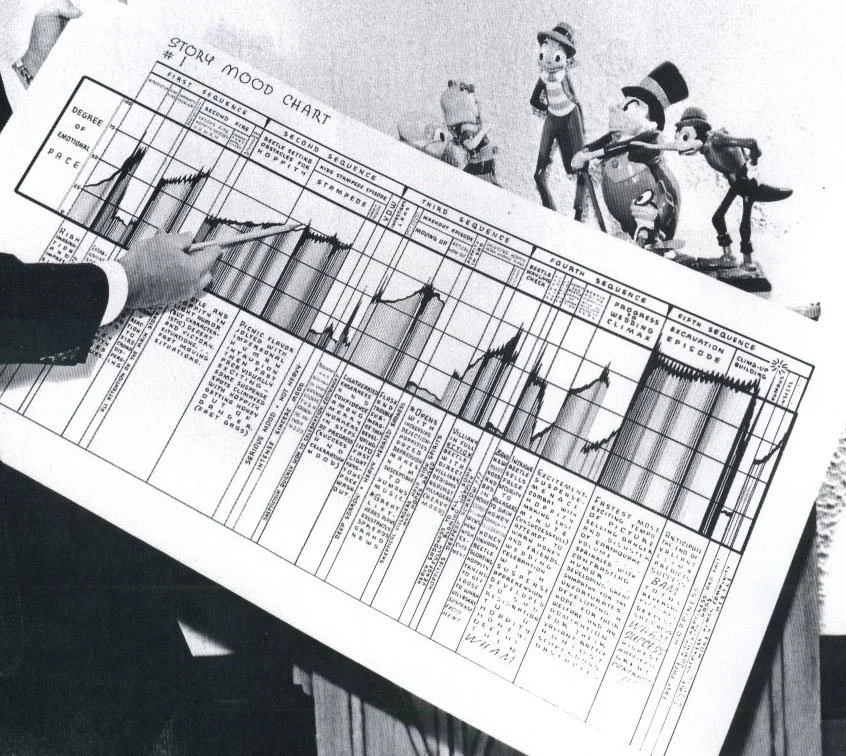
The studio developed a ‘Story Mood Chart’ for Mr. Bug to help artists better understand, sequence by sequence, the emotional pace of the film. It shows the ‘Fifth’ and ‘Sixth’ sequences as emotional high points.
Though not the only studio to create such a chart, it was an unusual project to undertake at this point in time.
We hope you enjoyed this glimpse into just some of the challenges and opportunities that Fleischer Studios faced during the making of Mr. Bug Goes to Town. Watch for the next installment! In Part Three we'll share the surprising story of Mr. Bug and its opening!