Celebrating a Century
1921 -
- 1929
The Out of the Inkwell Years
Part One: In the Beginning
Over one hundred years ago, in 1921, Max and Dave Fleischer rented a New York City basement apartment, hired a single employee, and Out of the Inkwell Studios was born. Today the studio is best known by the name it adopted in 1929, and holds to this day: Fleischer Studios.
Wildly creative and technically innovative, the “Out of the Inkwell” years (1921-1929) were responsible for some of the most iconic animated films of the century, the first use of synchronized sound, the invention of the bouncing ball, and the development of techniques that continue to shape the look, feel and sound of film to this day.
Originally posted in 2021, this centennial celebration tracks the remarkable, sometimes rocky, journey of Out of the Inkwell Studios, from a scrappy basement start-up that would go on to become one of the most influential animation studios of the 20th Century.
The Bray Years
Even before launching their own studio, Max and Dave Fleischer created more than twelve Out of the Inkwell cartoons for Bray Studios.
Animation pioneer J.R. Bray hired Max, who he’d worked with years earlier at the Brooklyn Eagle, after rather fortuitously running into him outside the office of Adolph Zukor, who Max hoped to interest in his invention, the Rotoscope.
Max had already spent two years trying, unsuccessfully, to get his invention off the ground. The Rotoscope enabled animators to create characters that moved with remarkably lifelike fluidity, but the process of creating rotoscoped films was slow, precise, painstaking. While many found it interesting, it was not considered practical. But Bray saw potential in Max and his invention. He hired Max, and before long, he hired Dave Fleischer as well.
The film the Fleischer brothers created to demonstrate the rotoscope featured the antics of a playful and remarkably lifelike clown based on Dave Fleischer. Dave had worked as a clown at Coney Island’s Steeplechase Amusement Park, and still had the costume. Remarkably, this clown and the inkwell from which it emerged would become the hallmarks of the Fleischer’s iconic rubber hose style of animation and their urban, sometimes gritty, often surreal sensibility that is known today as “East Coast” animation.
J.R. Bray
Along with his other assignments, Max produced more than a dozen Out of the Inkwell films for Bray Studios between 1918 and 1921. The “Little Clown” and his hijinks— often at the expense of his creator, played by Max— quickly became an audience favorite. The brothers had a hit on their hands. At the same time, Bray Studios found itself tangled in a series of contractual and legal issues that impacted everything from the funding to the distribution of new films.
Out of the Inkwell
Even with the rising popularity of their Out of the Inkwell series, launching an independent animation studio was a bold and risky enterprise.
First they would need funding. The brothers didn’t have much in the way of savings and had already invested much of what they did have (including a secret stash of $150 in household money from Max’s wife Essie) on building, testing, and patenting Max’s rotoscope. According to family lore, Dave was able to fund his own initial investment in the studio thanks to a lucky day at the racetrack.
The hours would be grueling. It took one year for the brothers to complete their first rotoscoped film in 1915. The one-minute film required a staggering 2,500 images to complete. During their time at Bray, the brothers had made great strides in streamlining this process and were able to turn out one Inkwell film per month by the time they left in 1921. But achieving this productivity with just Max, Dave, a one employee (animation photographer Charlie Schettler), would be a whole different story.
Max and Dave (likely 1919)
In addition to the time and expense involved in the production of animated films, there were the physical hazards. The film itself was highly flammable, and the ink and chemicals used throughout the animation process contained dangerous, often highly flammable fumes as well. The Studio’s first home, in a dingy basement apartment below a brothel at 129 East 45th Street, was not an ideal setting, especially for an enterprise that required long hours, good light, and plenty of ventilation.
Then there was the problem of distribution. Larger studios worked with teams of animators to keep new material, and necessary funding, flowing fast enough to meet an ever-increasing demand. But even with its impressive stable of ambitious and innovative animators, Bray struggled to meet commitments.
Remarkably, by 1938, Out of the Inkwell’s scrappy basement start-up had become Fleischer Studios, which inhabited four full floors at 1600 Broadway in midtown Manhattan and had over 250 employees. Even more remarkably, at the end of that very same year, they’d moved the entire studio from New York City into an enormous, state-of-the art facility in Miami, Florida where they soon employed a staff of more than 700.
How did they do it?
We’ll be spending the rest of this landmark 100th anniversary year sharing stories, photos and films that reflect on the Fleischer’s “Out of the Inkwell” years, and how the journey that started in a New York basement one hundred years ago changed the face of modern animation.
The staff at holiday party at the Paramount Hotel in 1936
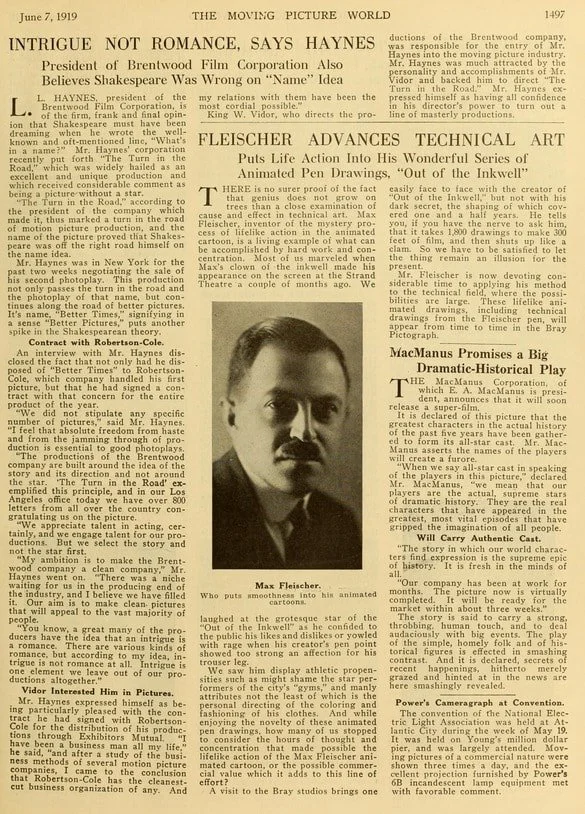
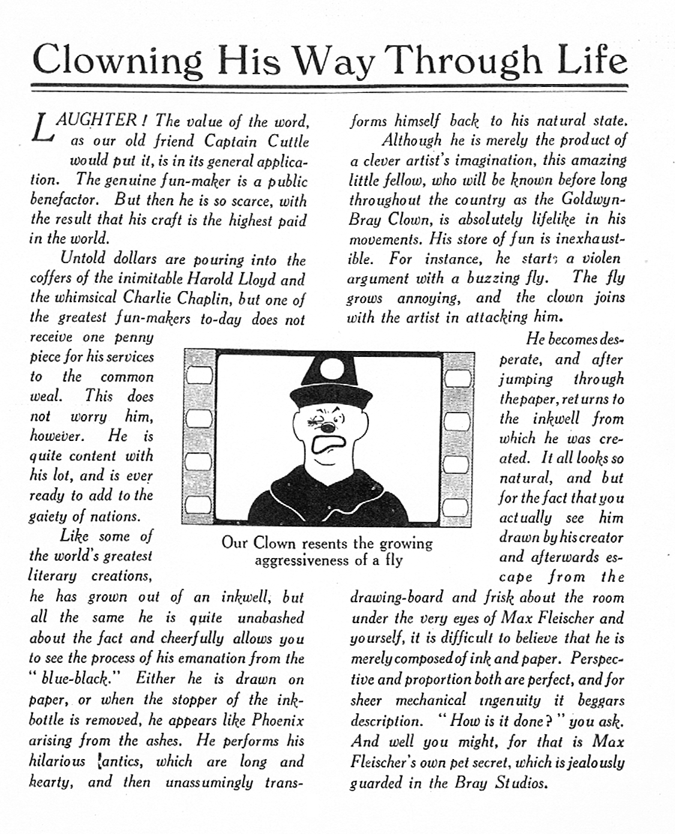
Pre-Inkwell Press
The two articles below, published while Max and Dave were still working at Bray Studios, speak to the public's interest in animated films featuring Max Fleischer and the "Little Clown."